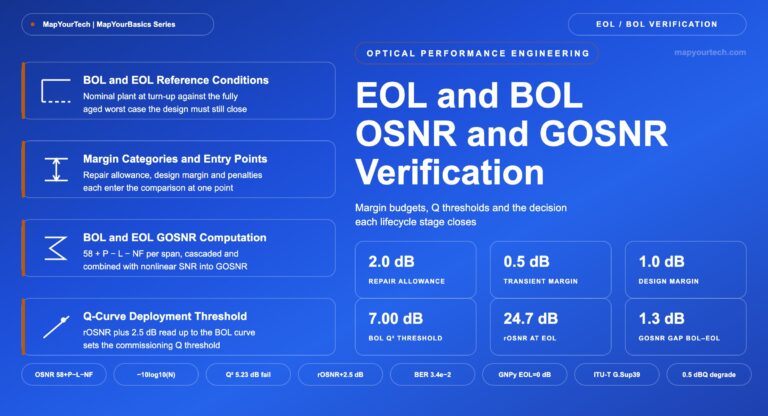
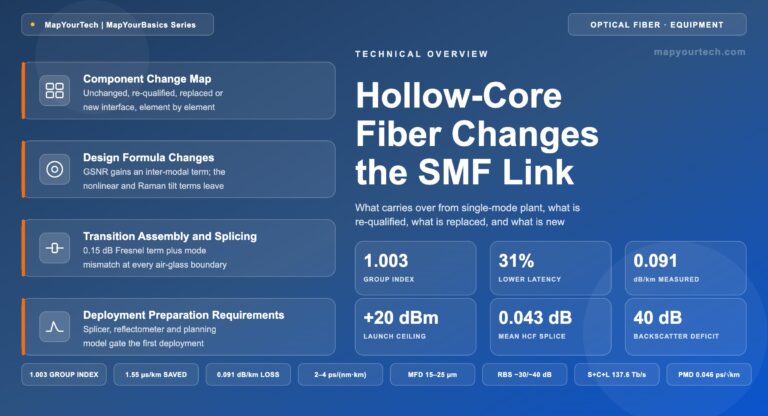
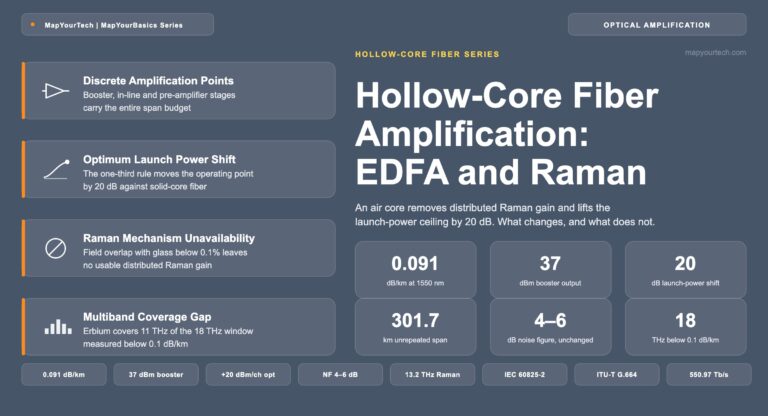

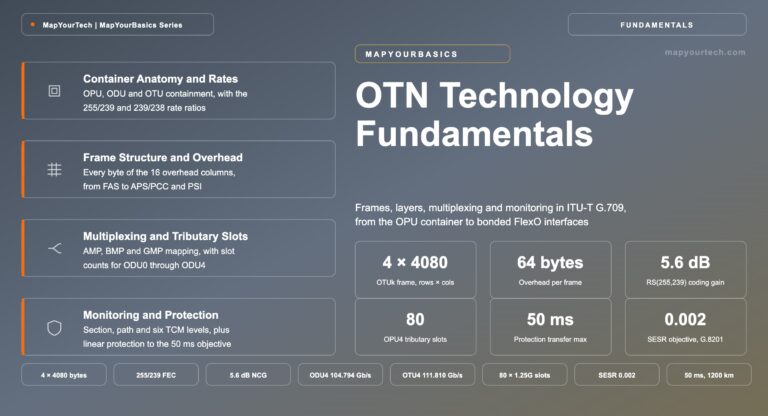






MapYourTech — Homepage Hero
Background
Colour
The Optical Engineer's Reference Platform

Learn, Simulate & Designthe best of optical networking.

Technical Articles to build your foundation, Courses to go deeper, Simulators and Calculators to design and practice, and Books based on industry experience — everything you need to excel at optical networking, in one place.

18+ years of hands-on optical networking, distilled — and still growing: from coherent optics and DWDM to terabit-scale networks
Vendor-neutral & technology-focused Globally trusted, 193+ countries Written by industry engineers Publishing since 2011
964+
Reference Articles
64+
Certified Courses
19+
Simulators & Tools
80+
Tech Infographics
3
Published Books
400K+
Global Visitors
MapYourTech — Pick Your Path
Start With Your Role

Pick Your Path — We'll Show You Where to Begin

Four roles, four starting points. Each path sequences the courses, simulators and references that match your work — so you begin at the right depth on day one.

954+ technical articles 64+ structured courses 32 tools and simulators 80+ infographics

Most items on every path open free with a MapYourTech account. If none of the four fits exactly, start with the Student path — all eight of its opening resources are free.

MapYourTech — Simulators and Calculators
Background
Colour
Interactive Engineering Tools

Simulators Built on Real Network Experience

Concatenate OSNR and GOSNR across spans, read a real OTDR trace, model Raman tilt over C+L, size a hollow-core splice, design a topology — 32 browser-based tools with validated physics, and most of them open free.

Span concatenation24.123.622.924.4per-span OSNR (dB)cumulative GOSNRspan 1 → 4END-TO-END GOSNR17.4 dB2.1 dB above limit
WORKBENCHFREE
Margin & Budget
OSNR and GOSNR Concatenation Workbench
Add per-span OSNR and GOSNR contributions in the linear domain and watch the end-to-end budget close — or fall short of the required value.
Linear-domain sum
Try Free
E1E2END
VIEWERFREE
Fiber Testing
MapYourOTDR Simulator and Viewer
Open a real .sor trace or generate a synthetic one. Event classification separates splices from connectors, with A/B span loss, ORL and a PDF report.
Event detection
Try Free
C+L SRS power tiltC-BandL-BandSRS TILT-1.8 dB96 ch, 100 km spanEqualization required
VISUALISERFREE
C+L Band Impairments
Optical C+L SRS Visualiser
Raman power transfer from the C-band blue edge into the L-band, shown per channel, with the tilt correction the line system has to apply.
Per-channel tilt
Try Free
Link budget breakdownFiberConnSpliceEDFAMARGIN RESULT3.2 dBavailable marginPASS — link viable
CALCULATORFREE
Link Planning
Optical Link Attenuation Calculator
Span length, connector count, splice count and fiber class in; an itemised loss breakdown and a pass or fail margin out.
No login needed
Try Free
Protected ring, one cut4 nodesROUTE AVAILABILITY99.982 %DOWNTIME/YR95 minMTTR8 h
SIMULATORFREE
Protection & Reliability
Fiber Cut and Availability Simulator
Set cut rate per 1000 km, repair time and topology, then read route availability and annual downtime for protected and unprotected paths.
Availability model
Try Free
Hollow-core to solid-core jointHCF, MFD 21 µmSMF, MFD 10.4 µmmode field mismatchsplice loss 0.62 dB
SIMULATORFREE
Hollow-Core Fiber
HCF Splice Loss Simulator
Mode field diameter mismatch, lateral offset and angular tilt at a hollow-core joint, resolved into a splice loss in dB before you order the fusion recipe.
MFD mismatch model
Try Free
One workspace, many conversionsdBm → mW1.26 mWλ → frequency193.4 THzcomposite power19.8 dBmreach estimate1240 kmCD accumulated1700 ps/nmQ → BER2.1e-3
TOOLKITFREE
Everyday Utilities
Optical Networking Toolkit
The conversions an engineer reaches for a dozen times a day — dBm and mW, wavelength and frequency, composite power, reach, dispersion, Q to BER — in one page.
No login needed
Try Free
Propagation delaymax delay pointSite ASite BONE-WAY14.7 msROUTE LENGTH3000 km
CALCULATORFREE
Latency & Propagation
Optical Fiber Latency Calculator
One-way and round-trip delay for any route, taking the fiber group index and equipment processing time into account rather than assuming c.
OWD and RTD
Try Free
OSNRGOSNRSpan number
SIMULATORPRO
OSNR & GOSNR
OSNR vs GOSNR Professional Simulator
Linear noise accumulation against nonlinear interference across a multi-span cascade, with real amplifier noise figures, compared from 100G to 400G.
Multi-span cascade
Try Now
Site-AROADM-NSite-B12.4 dB11.8 dB
PLANNERPRO
Network Design & Planning
OptiMap Pro Network Designer and Planner
Build a topology node by node, add spans, amplifiers and ROADM degrees, and let it compute end-to-end OSNR, span loss and the power budget.
Full topology builder
Try Now
Also available:GuardBand ProSpectraGuard ProEDFA Gain and NF SimulatorSubmarine Link SimulatorChannel Power EqualizerSpectral EfficiencyShannon Limit+15 more
View All 32 Tools
MapYourTech — Why Engineers Choose MapYourTech
Background
Colour
What Makes MapYourTech Different

Why Engineers Choose MapYourTech

Built on 18+ years of hands-on network engineering — every tool, course, and article is grounded in practical knowledge from designing, commissioning, and operating live optical networks.

Field-Validated Accuracy

Every specification checked against ITU-T, OIF and IEEE documents and real deployment data

Real Engineering Tools

19 tools including the GOSNR workbench and MapYourOTDR — most of them free, none of them videos

Find Answers Fast

Searchable text-first format — 964+ articles structured as engineering references

Always Current

800G, 1.6T, 400ZR, C+L band, CPO — tracks the standards as they move

Certified Learning Paths

64+ courses with assessments and LinkedIn-shareable certificates — 12 open free

Vendor-Neutral Since 2011

No marketing spin — read by engineers in 193+ countries across 15 years

Start Learning Free No credit card required. 12 free courses, free simulators, and free articles the moment you sign in.

Articles Free

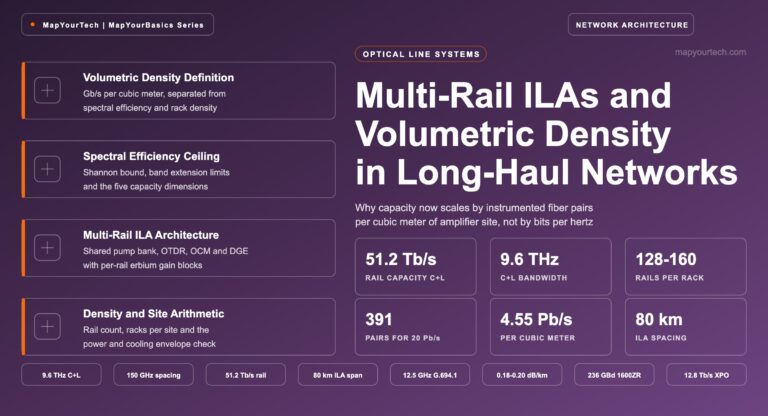
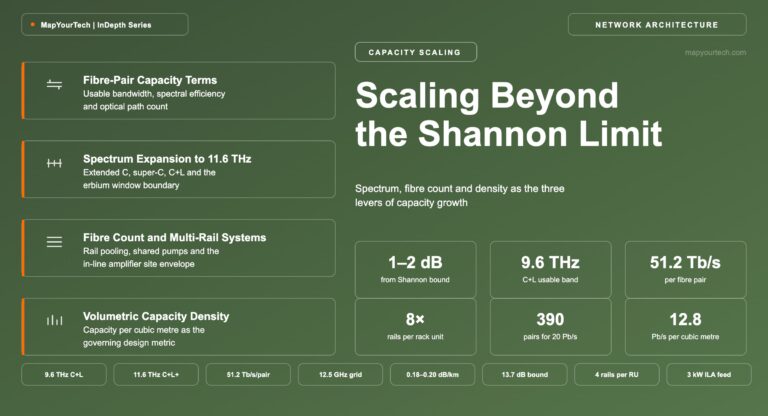
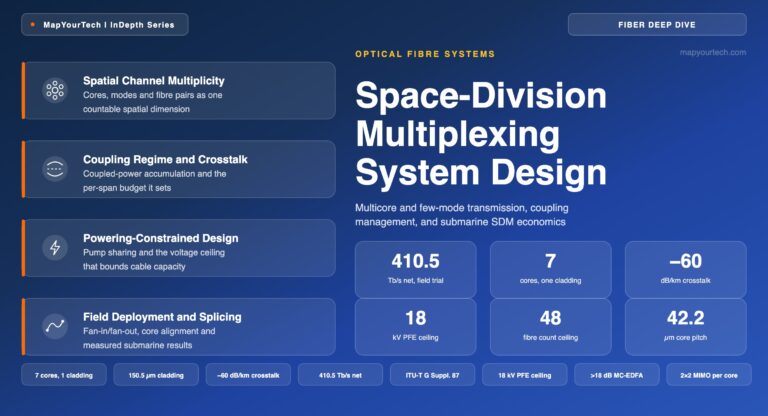
A visual guide to the fiber pair as the unit of optical capacity, the shared-hardware arithmetic …
  • Free
  • August 14, 2026
How the OIF baseline and the MSA extension diverge on forward error correction, frame containers, symbol …
  • Free
  • August 13, 2026
Test points, insertion loss allocation, eye limits, link training and client mapping across the short electrical channel …
  • Free
  • August 13, 2026
An application note on the power and thermal contract a line card owes a high-power coherent …
  • Free
  • August 13, 2026
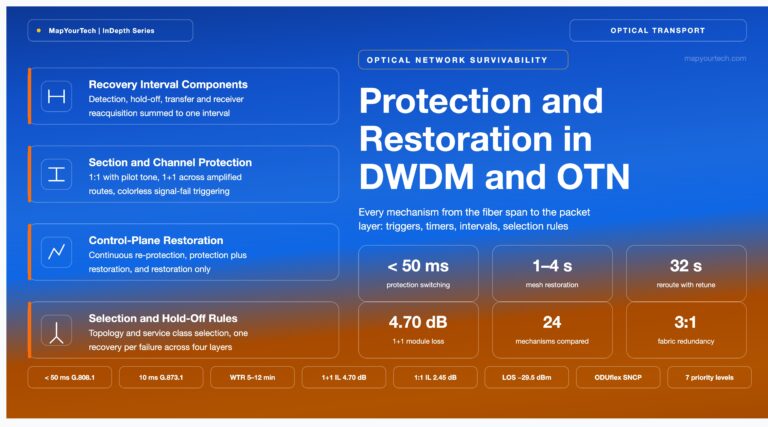
Four timing cases separate a 40 ms recovery from a 200 s one, and the difference …
  • Free
  • August 13, 2026
A long span fails in one of two distinct ways: the amplifier …
  • Free
  • August 12, 2026
Why cascaded pumping moves the gain region rather than simply adding gain, and what that buys on spans …
  • Free
  • August 12, 2026
Mirror steering sets the port count, transparency sets the service life, and insertion loss decides whether …
  • Free
  • August 5, 2026
Hard-decision and soft-decision coding, net coding gain, overhead and latency per family, and the interface class …
  • Free
  • August 5, 2026

Articles Premium

Every clock class a transport network carries, the traceability rules that connect them, and how the same hierarchy... …
  • Premium
  • August 14, 2026
... Membership Required You must be a member to access this content.View Membership LevelsAlready a member? Log in here
  • Premium
  • August 14, 2026
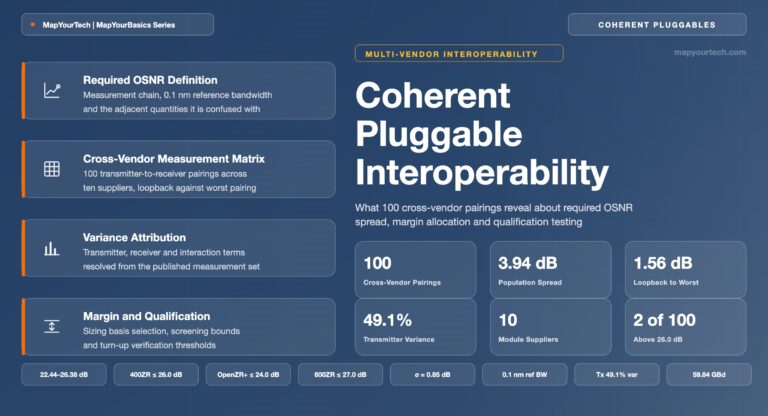
Required OSNR on a datasheet sits several decibels above the theoretical value for the same modulation and code. This article...
  • Premium
  • August 14, 2026
Converting concatenated PDL and DGD statistics into the outage-minutes figure a service-level... …
  • Premium
  • August 14, 2026
Mapping pre-FEC bit error ratio onto frame loss, error marking and delivered goodput on a coherent optical link. Coherent Transmission...
  • Premium
  • August 14, 2026
Which client combinations OIF 400ZR, OpenZR+ and OIF 800ZR accept, how those clients land in tributary slots, and why a......
  • Premium
  • August 14, 2026
How AMP, BMP and GMP absorb the frequency difference between a client and an independently clocked line container,... …
  • Premium
  • August 14, 2026
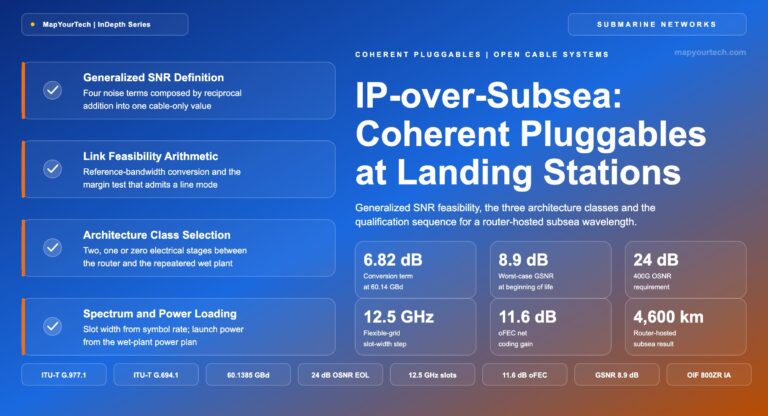
The no-mid-span-amplifier constraint and the four-stage amplification ladder that closes span loss from the shore alone: boosters, backward and third-order......
  • Premium
  • August 12, 2026
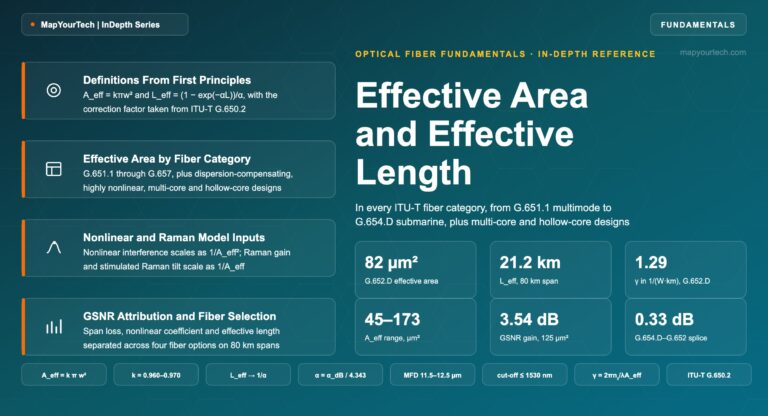
Every parameter on a single-mode fibre datasheet, defined against its ITU-T recommended value and mapped to the design decision it......
  • Premium
  • August 12, 2026

Courses Free

DWDM Technology

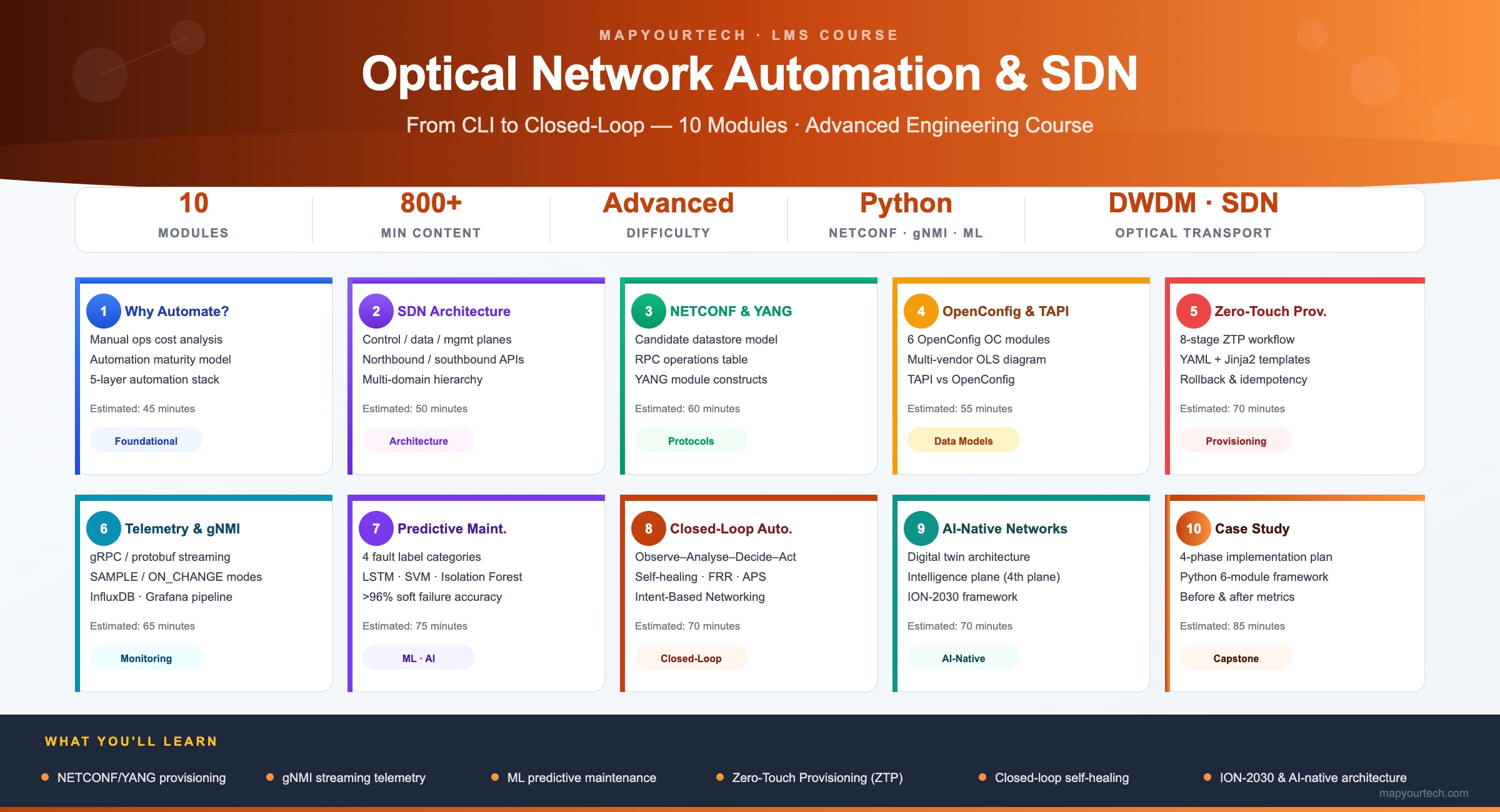
Question banks organized by role — OTN, DWDM, coherent optics, and network planning... …
  • 104 Lessons
Free

Advanced Technologies

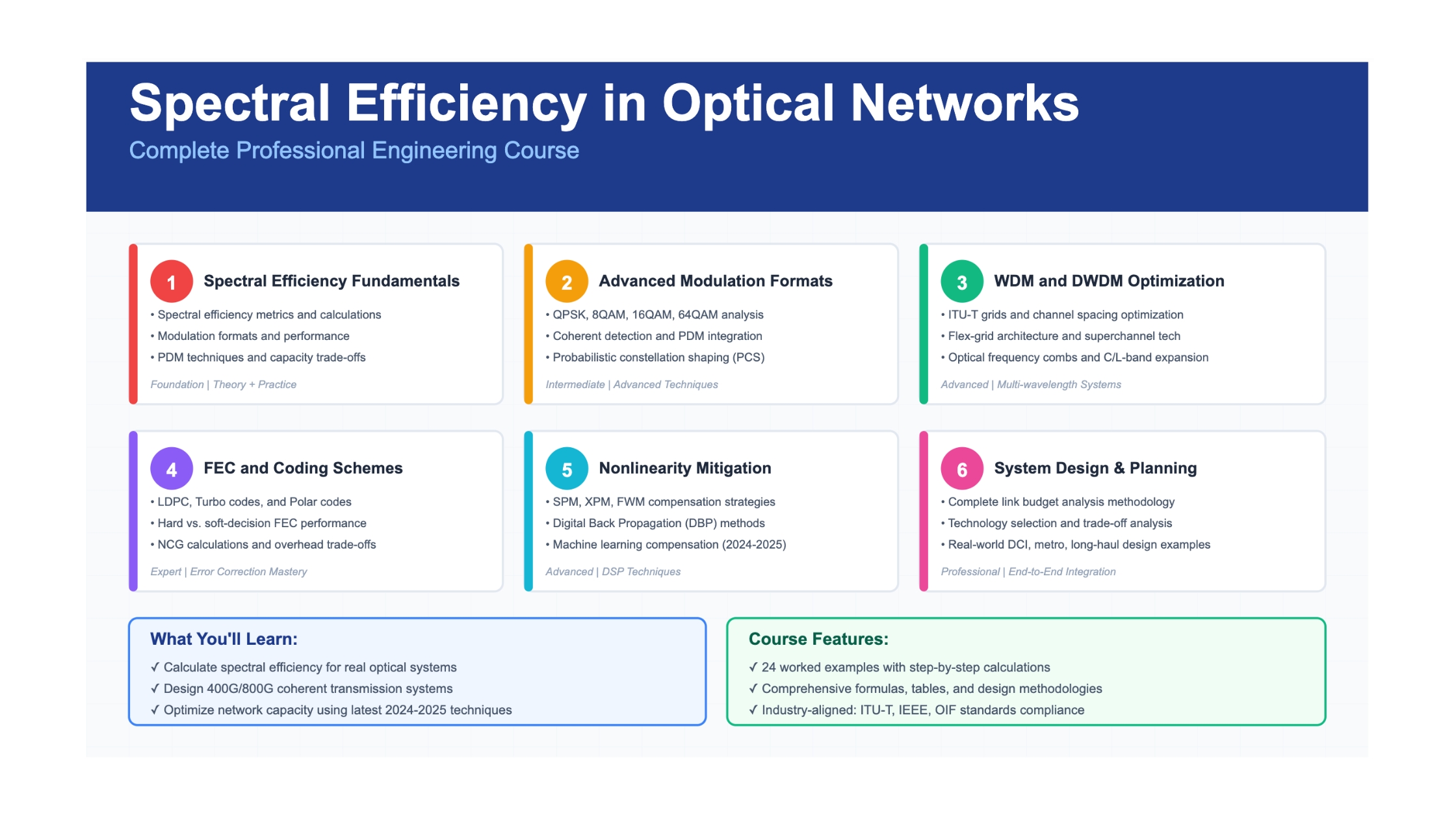
A Comprehensive Professional Engineering Course 6 Chapters 42 Sections 24 Assessments 24 Examples About This Course This professional-grade course provides comprehensive coverage of spectral efficiency principles and advanced techniques in...
  • 42 Lessons
Free

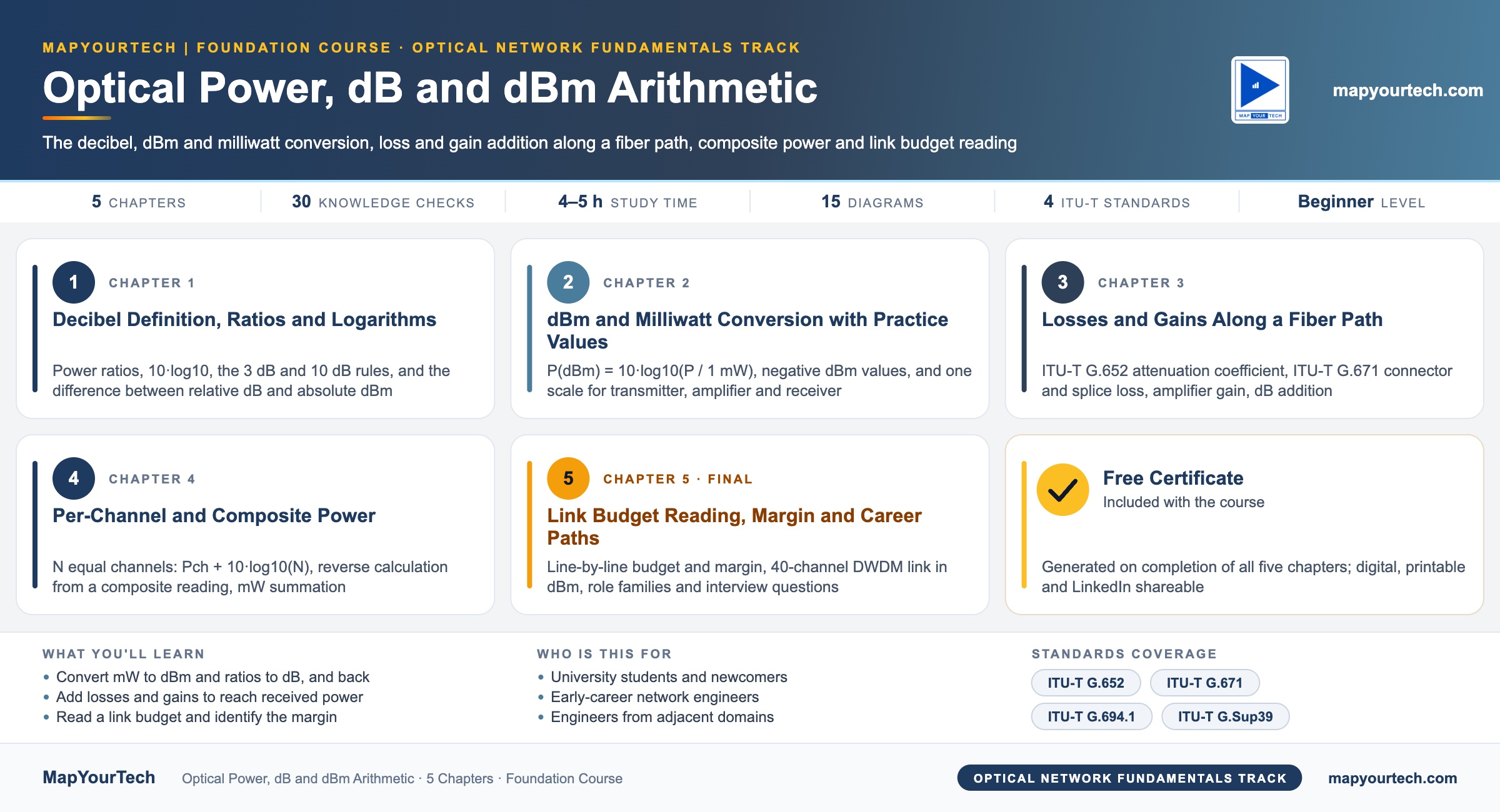
Optical Network Fundamentals

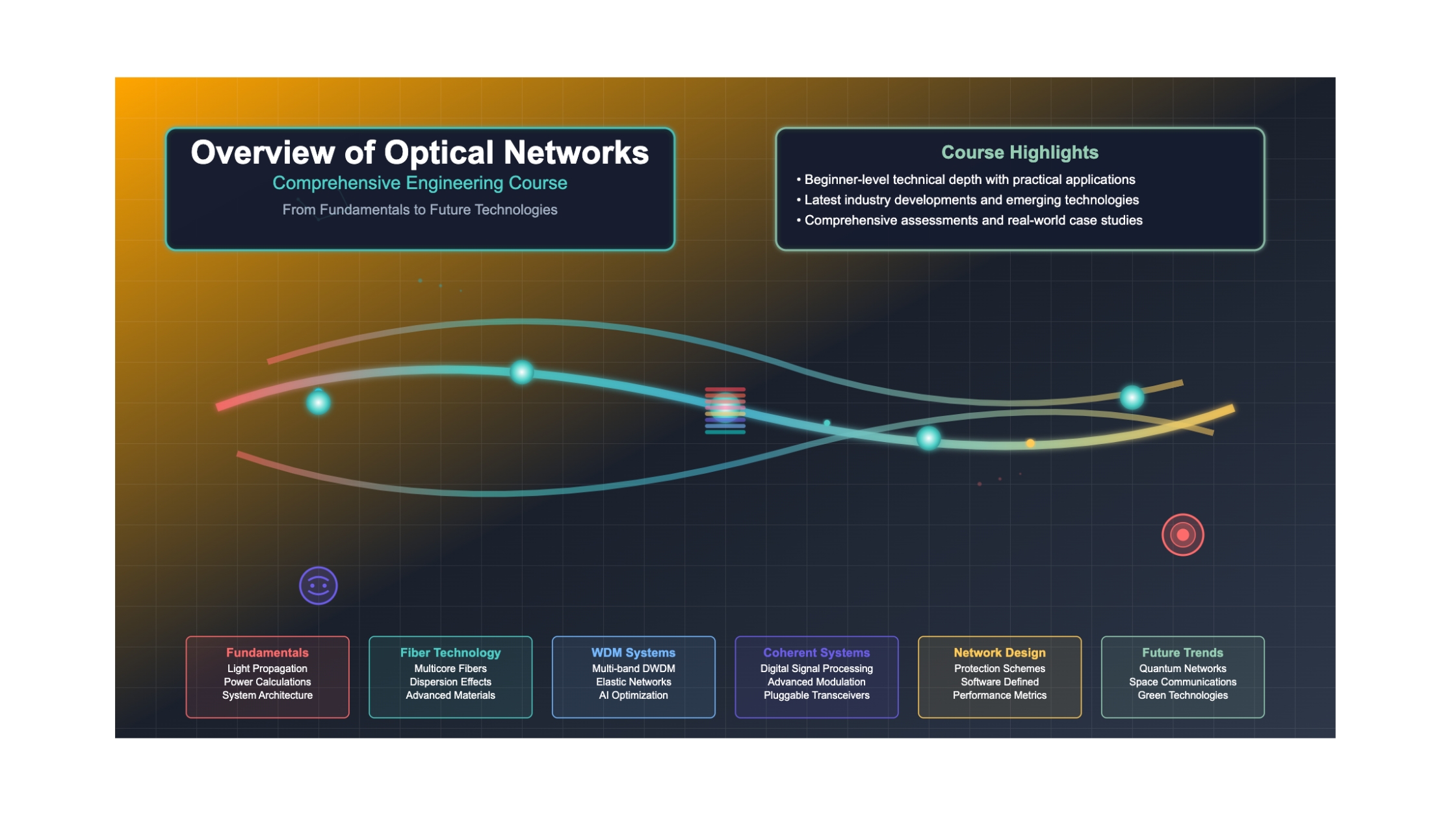
Learning Objectives Understand the fundamental concepts and terminology of Optical Transport Networks (OTN) Explain the evolution from legacy transport technologies (PDH/SDH/SONET) to OTN Identify the key drivers and business benefits...
  • 42 Lessons
Free

DWDM Technology

Learning Objectives Understand the fundamental principles of optical communication and light propagation Analyze the electromagnetic spectrum and optical window characteristics for fiber transmission Compare optical communication advantages over traditional electrical...
  • 61 Lessons
Free

Advanced Technologies

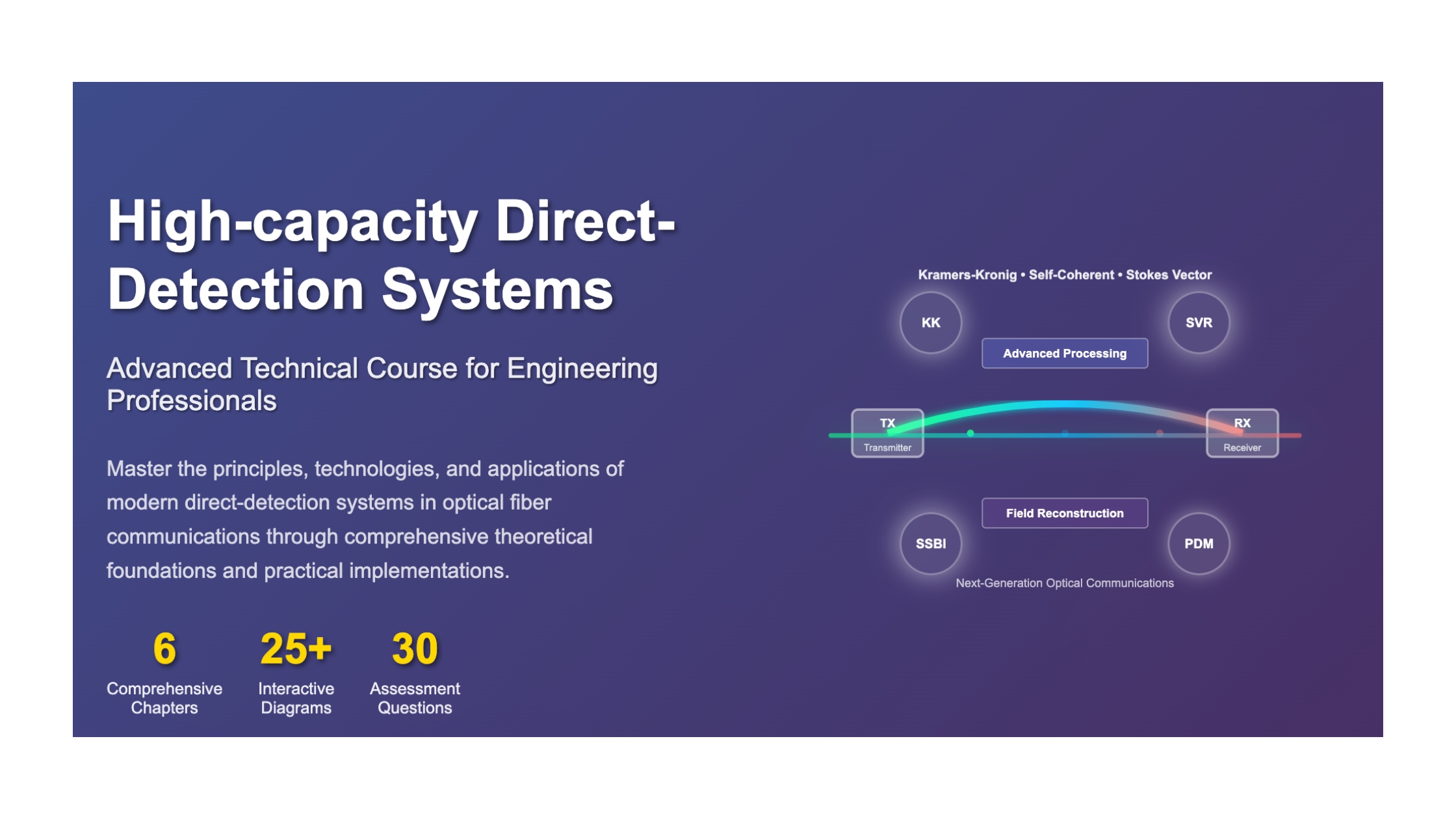
Learning Objectives Understand the fundamental principles of direct-detection optical communication systems Compare direct-detection systems with coherent detection systems Identify key applications and advantages of direct-detection technology Analyze the basic architecture...
  • 51 Lessons
Free

Advanced Technologies

Learning Objectives After completing this chapter, you should be able to: Explain the historical development and significance of undersea transmission systems Identify the key components and architecture of modern undersea...
  • 44 Lessons
Free

Courses Premium

Advanced Technologies

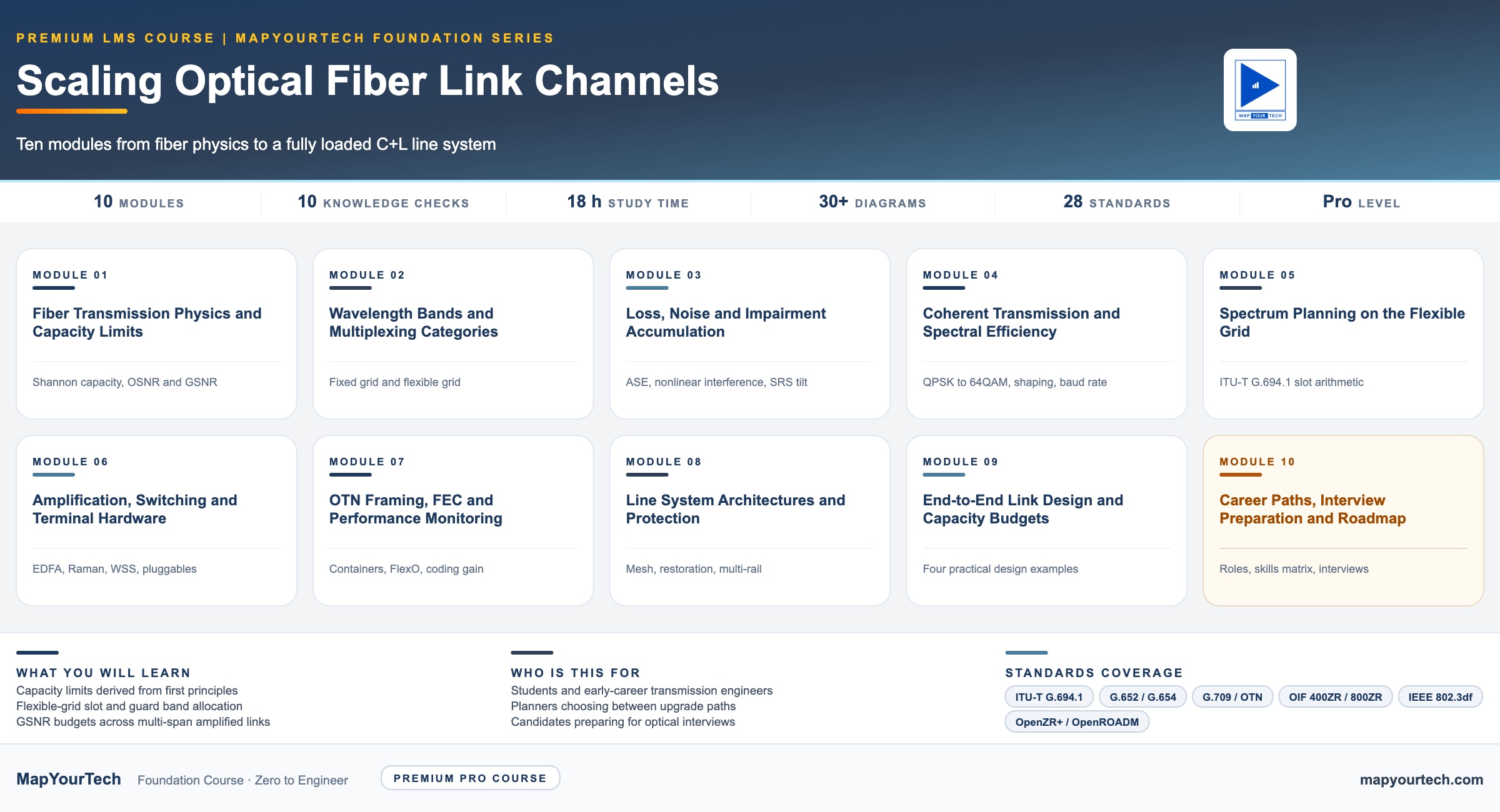
Design an optical amplifier line from first principles: EDFA gain and the noise-figure floor, ASE accumulation across a cascade, gain flatness and tilt, distributed Raman and hybrid... …
  • 82 Lessons
Free

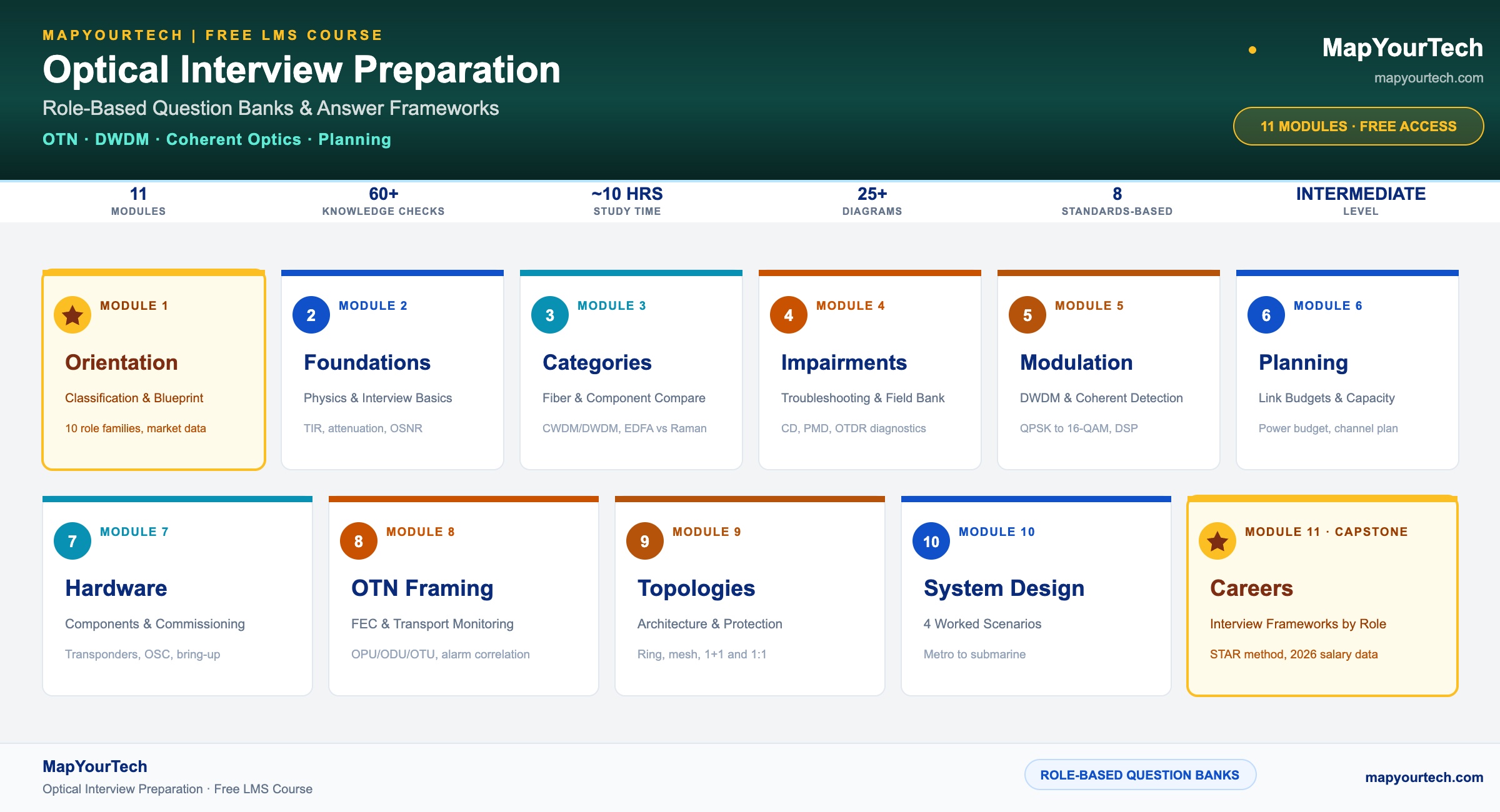
Interview Preparation

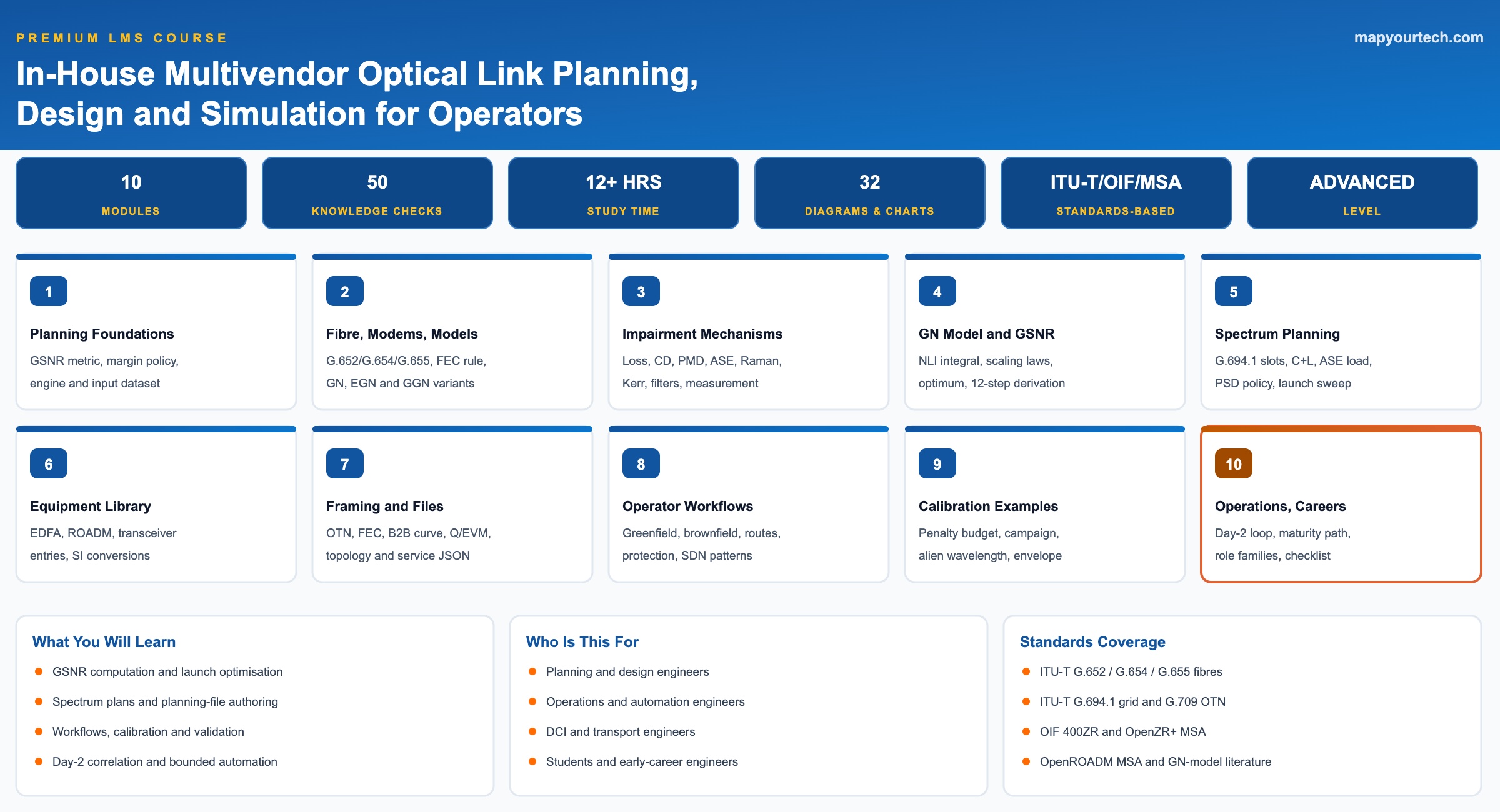
Turn a demand forecast into a spectrum and margin plan, predict quality of transmission with the GSNR framework, and defend every decibel of margin on a route. Ten modules run...
  • 100 Lessons
Free

Network Architecture & Design

Every parameter an optical network architect sets, checks, or defends in a design review — fiber class and effective area, span loss and margin, required... …
  • 121 Lessons
Free

Advanced Technologies

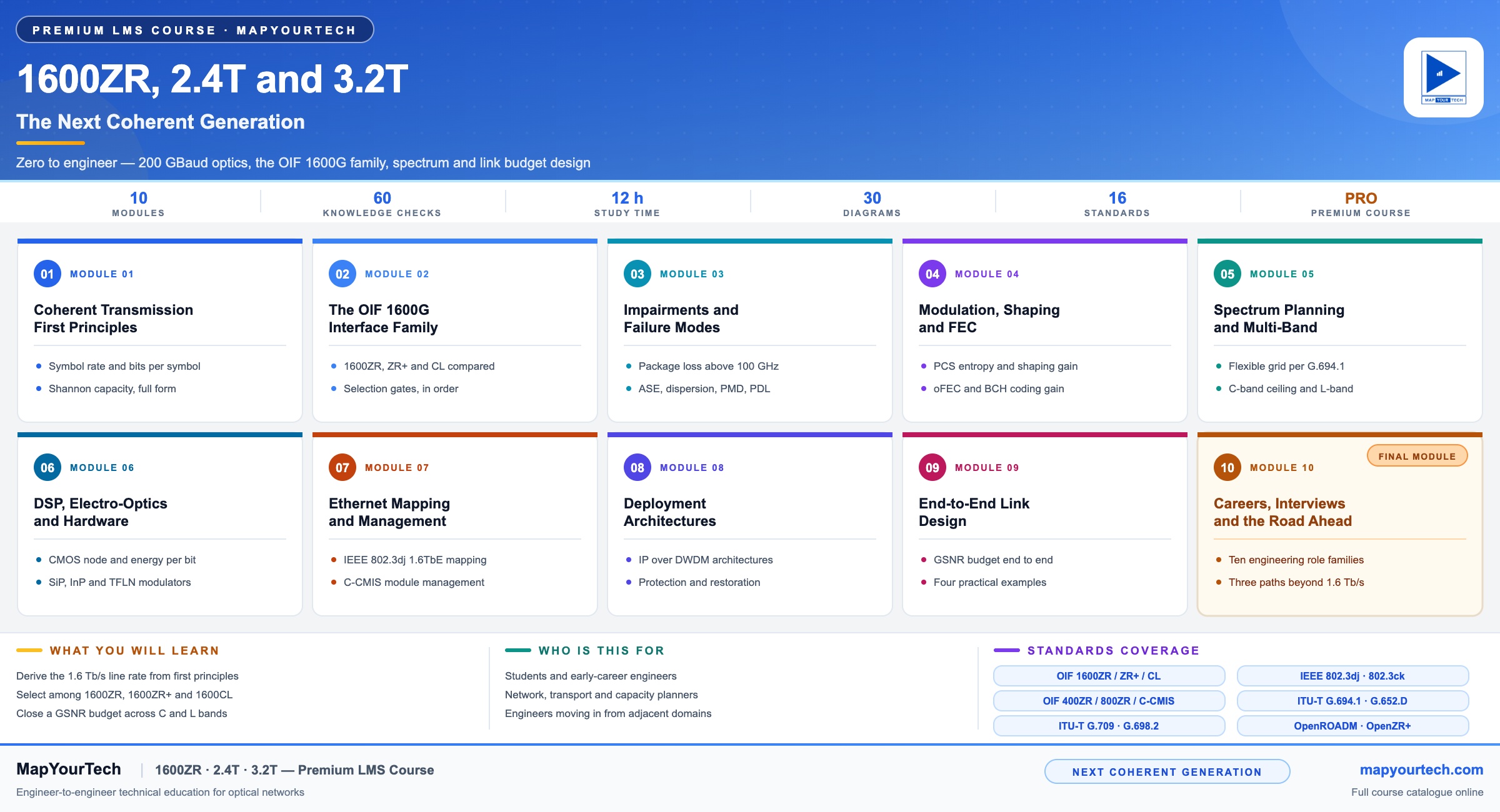
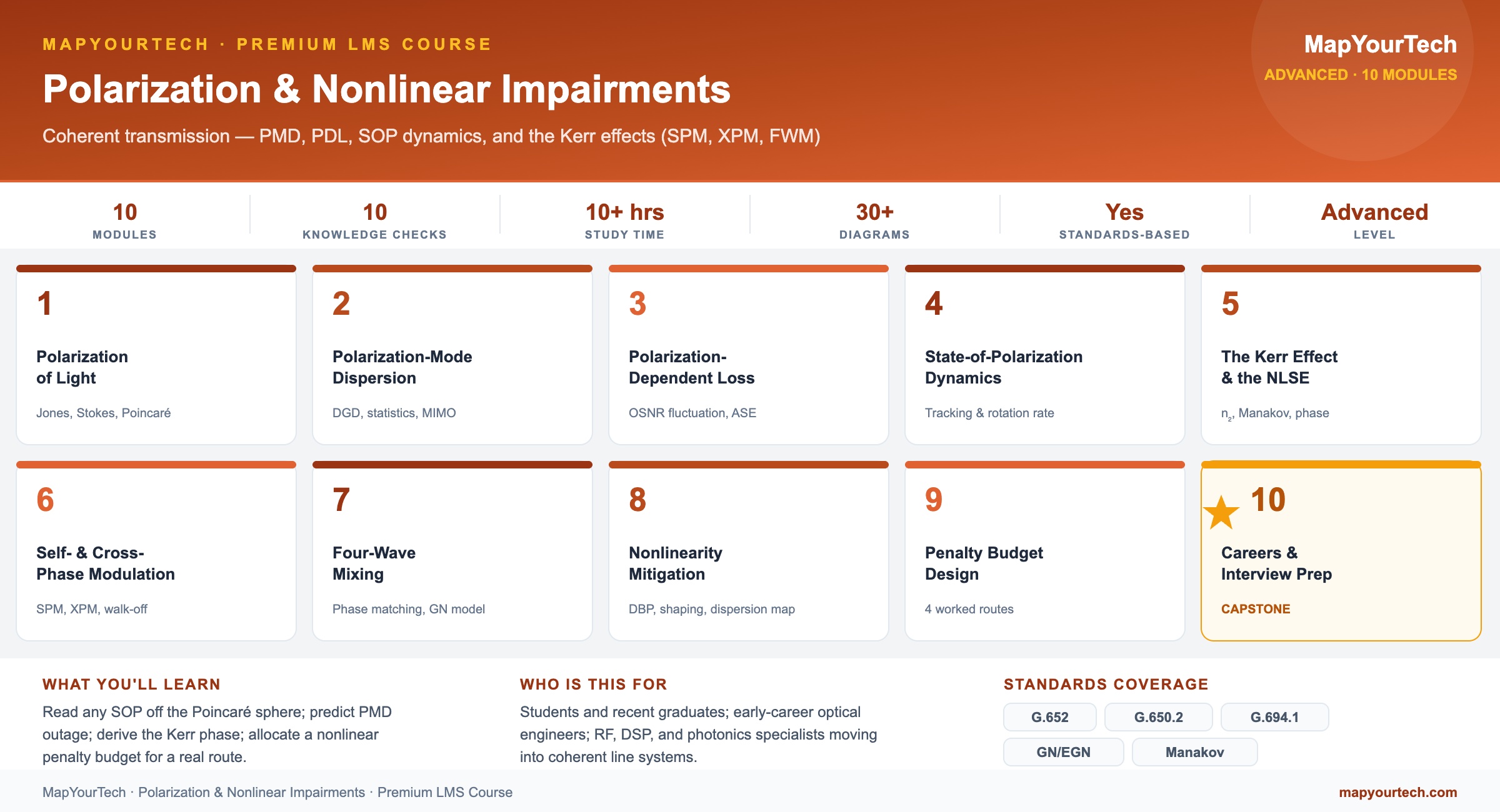
Ten modules that build from the complex optical field and IQ modulation through dual-polarization detection, receiver DSP, forward error correction, and... …
  • 101 Lessons
Free

Advanced Technologies

A complete OTN program from frame structure through the multiplexing hierarchy to client mapping decisions, with monitoring and tandem-connection exercises built on realistic service chains. Start... …
  • 91 Lessons
Free

Advanced Technologies

A zero-to-engineer journey through the money side of optical transport: CapEx and OpEx drivers, dollars-per-100G, power as an operating cost, router optics versus transponders, disaggregation, and the capacity-scaling economics that......
  • 91 Lessons
Free

Learning Paths Careers &

Positioning, role evolution, and a five-year roadmap for optical engineers as automation moves from... …
  • Premium
  • July 9, 2026
Order the sections, quantify the results, and format the page so a recruiter reads the right thing in the first...
  • Premium
  • July 5, 2026
Keep the framework’s discipline. Rebuild the delivery so the listener never notices the skeleton. 4 story... …
  • Premium
  • May 25, 2026
Most rejection emails tell you something useful. The trouble is that the useful part is buried under template language designed...
  • Premium
  • May 25, 2026
Three names on a list is not a reference strategy. One peer, one manager, one cross-functional partner —... …
  • Premium
  • May 25, 2026
Receiving feedback well is a working skill, not a personality trait. The engineers who treat it as a skill keep......
  • Premium
  • May 25, 2026
The bigger the failure, the more carefully you have to tell the story — four structural... …
  • Premium
  • May 25, 2026
MapYourTech — Career & Industry Intelligence
Career & Industry Intelligence

Know Your Worth. Win Your Interview. Read the Market.

Salary benchmarks worldwide, real interview questions with expert answers, and industry adoption signals — built specifically for optical networking professionals.

Salary Intelligence
Optical Engineering Salary Benchmarks
NOC / Transport (0–3 yrs)$62K–$88K
Network Design (3–6 yrs)$95K–$135K
Senior Architect (8–12 yrs)$XXX–$XXX
DCI / Coherent Engineer$XXX–$XXX
Submarine Systems Engineer$XXX–$XXX
3 of 5 ranges lockedPro plan covers all 18 roles × 6 regions.
Get Access
18 roles · 6 regionsFull Benchmarks
Interview Insights
Real Questions from Real Rounds
Tier-1 CarrierSr Engineer — Round 2
"Walk me through how you would debug a sudden OSNR degradation on a 96-channel DWDM link."
Check amplifier gain tilt first, then isolate by muting channel blocks of 8–12 wavelengths to identify whether the issue is broadband or channel-specific. Verify launch power at each ILA against the original commissioning baseline. Compare the current OTDR trace against the reference looking for new events or bend losses. If tilt is the culprit, adjust the gain equalizer at the affected node. If channel-specific, suspect transponder, MUX/DEMUX port, or VOA misconfig...
Continue with Pro
Also covered — 200+ questions
400ZR vs ZR+SRS in C+LDP-16QAM reachOTN overhead+199 more
200+ expert answersView All Questions
Free Resource
Quick Refresher — No Login Required
"What is the difference between OSNR and GOSNR, and why does it matter in 400G systems?"
OSNR measures linear noise only; GOSNR also accounts for nonlinear interference (NLI) from SPM, XPM, and FWM. In 400G with 16QAM and tighter spectral packing, NLI grows and the gap widens — a system that looks healthy on OSNR can still fail margin on GOSNR.
Full answer — Free
"Name three OTN overhead functions and their roles in transport network management."
TCM tracks performance across operator boundaries; PM tracks end-to-end path integrity using BIP-8; APS coordinates working/protect path switching during fiber cuts or node failures.
Full answer — Free
No login · Instant accessOpen Refresher
Market Intelligence
Industry Adoption Signals
800G CoherentScaling
400ZR / ZR+ in DCIMainstream
C+L Band BuildsExpanding
Open Line SystemsGrowing
53 premium reportsBrowse Reports
MapYourTech — Engineer Reviews
Trusted by Optical Engineers Worldwide

What Engineers Say About MapYourTech

Real feedback from engineers using the platform for design decisions, career growth, and daily reference

4.9
from 200+ engineer reviews
400K+Engineers worldwide
193+Countries · Global Reach
Verified User
Tools & Simulators

"OSNR calculator saved me hours of spreadsheet work"

Used the OSNR simulator and link budget calculator for an actual network design. Got results I could present directly in our engineering proposal.

A
AnuragNetwork Design Engineer
Course Graduate
Courses

"OTN course directly accelerated my promotion"

Completed OTN and coherent optics courses, earned certificates, added to LinkedIn. Within two months, a recruiter reached out about a senior role.

M
MohamedOptical Transport Engineer
Book Reader
Field Experience

"The bridge between theory and real deployments"

Unlike traditional academic texts, focuses on operational, maintenance, and development aspects engineers encounter daily.

E
Engineering ProfessionalOptical Network Engineer, APAC
Verified User
Automation

"Unlocked automation methods I didn't know existed"

After 18 years in telecom on SDH, IP/MPLS, and DWDM, MapYourTech unlocked automation methods that helped me reduce errors and speed operations across our production network.

D
DavidSenior Telecom Engineer
Career Insights User
Career Growth

"Career intelligence helped me negotiate a better role"

Practical information that helps professionals learn, excel, and advance. Salary benchmarks and interview prep gave me real negotiating power.

K
KumarPrincipal Engineer
Verified User
Articles

"Straight to the point — no filler content"

Written content I can read at my own pace. Real examples with code. No hour-long videos. Perfect for busy engineers who need answers during live troubleshooting.

V
Verified EngineerNetwork Operations, Tier-1 Carrier
MapYourTech — Plans and Pricing
Built by Engineers · For Optical Network Professionals

The Only Optical Networking Reference You’ll Need

The decisions that set a career happen without supervision: an alarm nobody else has seen, a design you have to defend, a claim you have to reject on your own evidence.

Reference-Grade Depth

One complete study per topic, not an introduction to five.

Validated Research

Every value checked against ITU-T, IEEE, IETF or OIF text.

Practical, Applied

The founder’s own 30,000+ hours designing and operating live networks.

Scope and limitations

No reference promises you a promotion or a passed design review, and nothing here replaces measuring your own fiber. What this one does promise: every value here was earned before it was written — 30,000+ hours on live networks, checked against the standards — so when it’s your call to make, you have everything you need to excel.

Save 25%

An engineer in design or operations spends roughly 1,800 working hours a year on decisions like those. Ten-seat team licenses run $2,250 a year; your own annual seat starts at $135 — under $0.08 per working hour.

Start Here
Free
Start learning with no commitment
$0/mo
Create Free Account
615 articles + 12 courses + 9 calculators — no credit card needed
Learning
Free Fundamental Courses
615+ Free Technical Articles
12 Free Courses
Tools & Reference
9+ Essential Calculators
4+ Developer Tools
Glossary, Alarms KB, Specs Reference
Most Popular
Premium
Reference-grade articles, complete simulators, market intelligence
$15/mo
$11.25/mo
$0.10 per working hour
Under $0.08 per working hour
Billed monthly at $15. Annual billing is 25% lower.
Billed annually at $135, one payment
Get Premium Access Get Premium — Annual
964+ articles + 64+ courses + 19 simulators + certificates
Premium Learning
52 Premium Courses
91+ Reference-Grade Articles
Request Articles on Any Topic
Engineering Tools
19 Professional Simulators & Calculators
80+ Technology Infographics
Market Intelligence
Market Research Hub (50+ reports)
LinkedIn-Shareable Certificates
Best Value
Premium Pro
Design-grade tools, the eBook library, and the careers and interview track
$25/mo
$18.75/mo
Under $0.17 per working hour
Under $0.13 per working hour
Billed monthly at $25. Annual billing is 25% lower.
Billed annually at $225, one payment
Get Premium Pro Get Premium Pro — Annual
Everything in Premium + 8 Pro-exclusive tools + 3 eBooks + the careers and interview track
Everything in Premium, plus
Careers & Learning Paths NEW
Learning paths by experience level — graduate to senior architect
Role-based question banks with answer frameworks NEW
Career Guide and interview preparation courses (129 lessons)
Interview Insights and Salary Insights by company
Pro Design & Simulation Tools (8)
OptiMap Pro network planner
GuardBand Pro
DWDM commissioning checklist
Submarine link simulator
OSNR vs GOSNR professional simulator
SpectraGuard Pro
DWDM OSNR/GSNR optimizer
Channel power equalizer
Library & Priority Support
3 MapYourTech eBooks, plus early access to future titles
Priority article requests
Early access to new features

Set this against the cost of one wrong span decision on your next project.

A simple way to choose — start Free to build fundamentals · pick Premium for the full working reference and simulators · pick Premium Pro if you design networks, are preparing for interviews, or negotiate compensation.

Volume pricing · 5+ seats
Teams and Enterprise

The per-seat rate drops below the individual price as seats grow. We invoice your company and accept purchase orders.

$2,250/yr
10 seats at the individual rate
Team quotes come in under this figure
Request team pricing

New! 48hr Premium Pro Plan

Experience everything MapYourTech offers — full Premium Pro access for 48 hours. Try before you subscribe!

$5
One-time • 48 Hours
Try Now →
Risk-Free Evaluation
$5 for 48 hours — full Premium Pro access, no auto-renewal, no card stored
Cancel anytime — you keep access until your billing period ends
Switch plans anytime — upgrade or downgrade from account settings
Secure payment — invoices and purchase orders on request
Instant access — everything unlocks the moment you subscribe
iOS app included — your subscription carries across web and app

Before You Decide — Read This

Honest answers to the questions engineers ask

Premium gives you the complete learning and simulation stack — every course, every reference-grade article, all professional simulators and calculators, market research reports, and LinkedIn-shareable certificates. Premium Pro layers on top: professional design tools built for real network engineering work (OptiMap Pro, GOSNR Simulator, GuardBand Pro, Submarine Link Simulator), the Careers and Learning Paths stream with its interview question banks and answer frameworks, the complete MapYourTech eBook library, and priority support. If you are preparing for a senior role, designing live networks, or negotiating compensation — Pro pays for itself.
Pay $5 once and get full Premium Pro access for 48 hours — every course, every tool, every simulator, every resource. There is no auto-renewal and no card stored for a future charge. If it fits the way you work, subscribe to a monthly or annual plan when you’re ready.
The $5 / 48-hour trial gives you full Premium Pro access to explore everything before you commit — every tool, every course, every reference. If after subscribing you find it isn’t quite the right fit within the first 7 days, contact us at admin@mapyourtech.com and we’ll work with you directly. We built this for engineers who need accuracy and depth, and we stand behind it completely.
AI tools and YouTube tutorials are great for a quick overview and orientation. Optical networking, though, runs on exact values, real-world parameters, and calculations you can put straight into a proposal or RFP. A chatbot produces plausible answers that can be wrong at random; every article and simulator here is verified against ITU-T and IEEE standards and validated against live deployments. And a chatbot can’t be an interactive OSNR simulator or an OTDR trace viewer — our tools use actual component specifications, not generic placeholders. When you are the only engineer on shift, or defending a design in front of a client, you have answers you can trust without a second thought.
Yes. Upgrade, downgrade, or cancel directly from your account settings at any time. No contracts, no fees, no friction. If you cancel, you keep full access until your current billing period ends.
MapYourTech is built specifically for optical engineers who want depth and applicability in one place. From component physics through full network design, with interactive simulators that use real parameters — every topic is covered to the level you need on the job. Take ROADM architecture: most resources give you a textbook overview. Here, you get CDC-F vs fixed-grid trade-offs, field deployment considerations vendors don’t document, OSNR impact at each degree, and interactive tools where you model your own scenario. Each premium article is written to be a complete reference — read it once and you’ll have everything you need to fully understand the topic. Every article is built from 18+ years of hands-on experience across live operator networks on multiple continents.
Every number is checked against published standards — ITU-T, IEEE, IETF, OIF — or against validated deployment data, and the simulators use real component parameters, not placeholders. Content is written and reviewed by the founder, a practicing optical engineer with 18+ years — over 30,000 working hours — of field experience across DWDM, OTN, coherent optics, and submarine systems, and it draws on three published reference books. The goal is material you can cite in a design document or RFP without needing a second source.
MapYourTech eBooks are written by a practicing engineer with 18+ years of field experience, focused entirely on what you need on the job: how technologies behave in live deployments, real design trade-offs, and the practical skills that bridge textbook knowledge and production-ready engineering. Where most references stay theoretical, these are written for engineers who design and deploy networks. Premium Pro members get the complete eBook library, including early access to future titles as they’re written.
A free tier of essential calculators is open to everyone. Premium adds the full set of professional simulators and calculators; Premium Pro adds the design-grade tools — the OptiMap Pro network planner, the OSNR vs GOSNR simulator, GuardBand Pro, the Submarine Link Simulator, and the intelligent optimizers for OSNR/GSNR, channel power, and amplifier placement. These are interactive engines you model your own scenarios in, not static references.
Yes. Completing a course earns a certificate you can share on LinkedIn as evidence of structured, standards-based learning. Members regularly add them to their profiles — and several have credited that visibility with recruiter interest and a step up in their careers.
New articles, course modules, and tool updates ship every week. When a new ITU-T recommendation is published, when OFC papers reveal a new coherent technique, or when a vendor announces a new transceiver architecture — the content reflects it within days, not months. Existing articles are revised as standards evolve, so nothing goes stale. Your subscription gives you a living reference library, not a static archive.
Yes. Premium members can request articles on topics they want covered, and Premium Pro members get priority on those requests. It’s one of the ways the library grows around what engineers need on the job.
Premium Pro carries a dedicated Careers and Learning Paths stream, and it is organised by where you are rather than by topic: what a graduate should be able to derive, what a design engineer is expected to defend, what a senior architect is asked to justify. Alongside it sit two full courses — a career guide covering practical skills, role definitions and interview readiness across 85 lessons, and a cloud-provider interview preparation course across 44 — plus Interview Insights and Salary Insights by company, so you prepare and negotiate from data rather than guesswork. Engineers across six continents use the platform, from fresh graduates to principal engineers designing transoceanic systems.
Yes — and many do. Engineers regularly expense MapYourTech through their company’s learning and development budget. At $15–$25/month, it falls well within most L&D approval thresholds and is often approved without manager escalation. We provide proper invoices and payment receipts. If your company needs a purchase order or additional documentation, contact us at admin@mapyourtech.com.
Yes. For teams of 5 or more, contact us at admin@mapyourtech.com for volume pricing and custom training solutions tailored to your team’s technical level and focus areas. Ten seats at the individual annual rate come to $2,250 a year and volume pricing comes in under that. Certificates also give you a record of what the team has covered.
Yes — invoices and payment receipts are available, and we can issue or accept a purchase order where your company requires one. Just reach out at admin@mapyourtech.com and we’ll sort the documentation.
Yes — the MapYourTech Pro app is available on iOS, so you can read articles and reference material on the move. Your subscription carries across web and app.
The prices on this page are the prices. Annual billing is 25% below monthly because one payment covers a full year of publishing and costs less to process. Beyond that we would rather add value than cut the number: teams of 5 or more get volume pricing, Premium Pro carries the eBook library and priority requests, and every plan keeps everything published during your term. Three months of Premium costs less than one optical networking textbook, and new content ships every week. If a plan is not worth its price to you, the $5 48-hour pass establishes that for $5 rather than for a year.
Questions grouped by the role being hired for — operations, planning and design, systems engineering — each one paired with an answer framework rather than a model answer. The framework names what the interviewer is testing, the order to build the answer in, the value or standard clause that anchors it, and the follow-up that usually comes next. Asked why OSNR degrades along a span, for instance, a graduate is expected to reach the 10·log₁₀(N) accumulation; a design engineer is expected to separate linear noise from nonlinear interference and say which one binds. The technical material is the same reference library the rest of the platform is built from, so you are not memorising interview answers separately from the engineering.
MapYourTech — Books

Books by MapYourTech

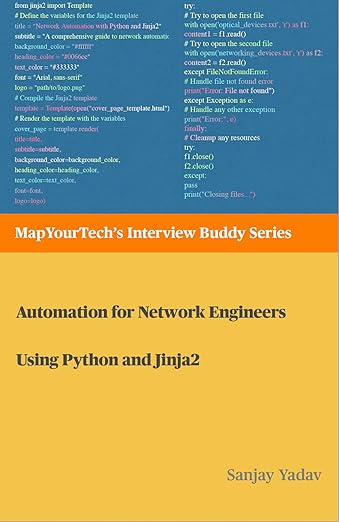
Three books, one author — founder Sanjay Yadav, 18+ years in optical networking · 800+ copies sold

Personally watermarked — your name, your copy, yours to keep Secure Stripe Payments Instant Digital Download PDF & EPUB Formats
MapYourTech — iOS Apps
MapYourTech Apps

Optical engineering tools, in your pocket.

Native iOS apps that put the platform, calculators and trace tools you use on the bench onto your phone — built by the same engineers behind MapYourTech.

MapYourTech Pro
iPhone & iPadFree

The full MapYourTech website on your phone — articles, courses and tools, all in one app.

MapYourOTDR
iPhone & iPadFree

Open any .sor trace — event classification, A/B span loss, ORL and bidirectional splice loss. PDF reports, offline.

Optical Toolkit
iPhone & iPadFree

47 calculators, 59 reference tables and a native OTDR .sor reader — fully offline, no data collected.

MapYourContact
iPhone & iPadFree

Turn your contact details, LinkedIn or any link into a styled, scannable QR code. Offline, no account.

Coming soon More field tools are on the way, built to the same standard — launching through the year.
Community · Live
Join the conversation

Ask questions, share what you're learning, and connect with engineers across optical networking.

Open the Community